Halloween movies from the past

By Jen Luu

Remember when you were a child, exhausted after an endless Halloween adventure of scouting your neighborhood in search of candy?  You and your friends settle down, pouring a stream of vibrant treasures that range from lollipops to chocolates to gummies.  As you exchange a KitKat for a Milky Way, a familiar movie appears on the TV that signals the resolution of a hectic night.

Classic Halloween movies that people know and love from the late 1990s to the early 2000s have declined in popularity.  Despite the end of an era, these movies still evoke a fond sense of nostalgia to those who grew up watching them.  Spongebob’s Halloween special conveys the tale of how Spongebob fears everything, ultimately earning him the nickname “Scaredy Pants.” Scary Godmother: Halloween Spooktacular portrays how a group of teenagers temporarily abandoned a little girl, Hannah, in a haunted house.  Hannah meets her Scary Godmother and becomes acquainted with several monster friends, proving her bravery to everyone else.  In Foster’s Home for Imaginary Friends’ “Nightmare on Wilson Way,” Bloo attempts to inflict fear upon everyone through tacky tricks.  Little does he realize that his traps backfire as zombified versions of his friends haunt him throughout his schemes.

These beloved movies that once characterized our childhoods serve as a warm contrast to the transition to adulthood.  They remind us of the simple pleasures of being a kid.  In the midst of meeting the demands of high school, don’t forget to embrace the nostalgic Halloween spirit!

How to stay in shape after Halloween

By Syed Rahim

Like millions of Americans nationwide, you’re probably trick-or-treating this Halloween.  And, like those millions of Americans, you’re probably salivating over the thought of free chocolate.  But for some with concerns over their health, the holiday poses a tricky question: is it possible to stay healthy while still enjoying Halloween?

“Nutritionally and dentally speaking, the modern-day Halloween is kind of a disaster,” says Harvard Health contributor Andrew Wehrwein.  “Certain kinds of candy may be hard on teeth, apart from promoting cavities.”

Mr. Wehrwein isn’t alone.  Among concerned parents and pediatricians across the globe, the same words are echoed.  And if that isn’t enough, increasing amounts of research show that candy can cause cavities and erode tooth enamel, stacking on yet another layer of stress to parents and guardians.

If you’re reading this and worrying about a few extra pounds, don’t throw out your costume just yet.  Halloween, much like the chocolate it celebrates, is multi-layered:  a hard, discouraging exterior is soon met with a rewarding nougat center.  To put it in less confusing terms, a healthy Halloween is possible with simply hard work and calorie counting.  For example, a fun-size Snickers bar contains 80 calories.  A nice 20 minute walk around the neighborhood will burn 50.  A brisk seven minute run will burn 80.  Balancing your intake with a healthy regimen will ensure your fitness.  If your health is a concern, strap your running shoes onto your Hans and Franz costume and jog an extra lap around the neighborhood.  In time, you’ll find a reward sweeter than any candy.

Cultures, not costumes

cs-02-culturalappropriation-vivianlin-f

By Vivian Lin

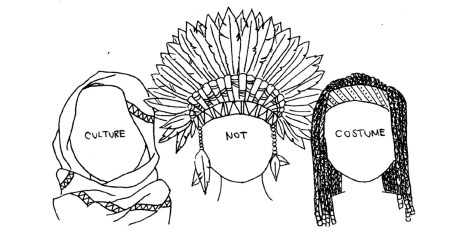
Still don’t know what to wear for Halloween?  While Halloween brings fun nights of trick-or-treating in your costumes, it is important to be mindful towards other people’s cultures in your costumes.  Cultural appropriation has been a raging issue in the media, from music festivals to holidays, especially Halloween.  But what is cultural appropriation?

“For me, cultural appropriation is using someone else’s culture without understanding it, using it frivolously, ” claimed sophomore Aayushi Shah.

Certain costumes depicting “native” headdresses and “oriental” qipaos can be offensive towards people of that ethnic background because it is turning their culture, something with centuries of rich history, into a silly and shallow costume.

“You’re taking something that is very sacred and you’re being offensive with it.” remarked social science teacher Jeff Loggins.

With all this controversy over cultural appropriation, some people might be hesitant to engage in discussions or events regarding other cultures.  That’s where cultural appreciation comes in.

“If you’re trying to learn something about a culture, and a teacher dresses a certain way to teach a lesson, then it’s cultural appreciation,” explained Spanish teacher Claire  Gonzalez.

“Appropriation is when you pick it for yourself and you don’t respect the other culture.  It’s appreciation if you respect the culture and if someone from the culture invites you to celebrate,” elaborated sophomore Kristle Dela Cruz.

To avoid insensitivity this Halloween, make sure you check yourself before going out in your costume.  Ask yourself: Would you wear it in front of a person of that culture? If you’re having doubts about whether or not it is offensive, chances are that it is.  Better safe than sorry!

Bring Back AP Computer Science

By Walt Leung

AP Computer Science.  AP Java.  APCS.  Whatever you call the class, a key problem remains at this campus: Piedmont Hills High School resides in the heart of Silicon Valley, but does not offer a computer science course.

The relationship of the 21st century will be defined by man and machine.  The binary system with its ones and zeros has already taken its place in society, and is continuing to expand its influence.  In medicine, researchers use Perl to sequence genomes.  In finance, investors implement HTML into online banking systems for clients.  In art, designers value Java to create a multitude of graphics.

Yet, computer science is an often misunderstood subject.  Ask the vast majority of the graduating senior class: many of us express a desire to major in some form of computer science in college, but only a handful have programming experience.  And once introduced in college, some find programming mundane and attempt to move into other subjects.  We are undoubtedly forced into this field, whether from parents in engineering fields or from industry leaders such as Steve Jobs and Mark Zuckerberg.  We learn subjects such as calculus and physics because we are told they resonate with computer science.  But if you stop and think, how can learning integration or special relativity be critical to writing C++?

By no means am I arguing that students cannot aimlessly walk into the world of computer science, find love for the subject, and succeed in their fields; many have done so in the past, and many will do so in the future.  But for the amount of preaching we receive on landing the ideal job that makes us happy, I find irony in the sheer amount that are willing to blindly pursue a path that they don’t even know the fundamentals of.  What if you had to spend the next four years of your life learning about Greek literature?  Or even worse, mathematics?  No offense to those whom actually love these subjects—I am merely expressing my interests.

Computing is a world built by the user, molded by the imagination.  It is the ultimate medium for expression, a platform free of limitation.  A computer science course will not just offer an opportunity to thousands of students at Piedmont Hills; it will also give college-bound students a chance to explore their interests.  Whether it’s Python, Java or MATLAB, computer science boasts an incredible range of versatility and practicality.  Fortunately, some teachers have begun to express interest in teaching a computer science class; Mr. Luc, for example, is willing to lead an AP Computer Science course as an experimental class for the 2016-2017 school year, and he needs at least 30 students to sign up.

Scheduling ends in a few days.  I strongly urge those whom wish to pursue an engineering-related field—and there are many—to sign up for computer science.  Thirty students may seem like a lot, but it’s only a fraction of the students that will check “Computer Science” on their UC applications.  Enroll in a class that will hopefully shed some light on your future, and it may turn into the most valuable choice of your high school career.

Why you should join Journalism

By Kylie Cheng

Around this time last year, The Legend seemed close to death; scheduling for the year 2015-2016 showed that too few students had signed up for Journalism.  Eventually, enough willing people signed up and saved the class, and the school newspaper lives for its 50th year.

Perhaps the majority of students still think of Journalism as undesirable.  The class includes challenges not everyone may wish to face—but it also provides an environment to cultivate skills that few other classes exercise.

One of the most common objections to taking Journalism is the writing it requires.  The benefits from news writing, however, are different from those gained from an A-G English class.

“A lot of people don’t want to take Journalism because they don’t like writing, or they think they can’t write,” muses Copy Editor Michelle Fong.  “They think they can’t write good essays, which has nothing to do with Journalism.  It’s more like taking facts, putting them on a sheet of paper and then formatting it.”

News writing differs from the academic writing most high school students are used to, as well as from creative writing.  The majority of news stories fit an “Inverted Pyramid” that organizes facts from most to least important, while alternating between quotes from the people involved and paraphrases or additional information.  This structure relieves the journalist from having to come up with original content.  Furthermore, it focuses on accuracy and clarity, not on writing flowery sentences to impress the English teacher.

“It’s easier to get away with style anomalies because there’s a clear format, like the news story format, the multifeature format, even the opinion format,” says News Editor Tiffany Lee.

The editors appreciate a writer with above-average flair, but as long as students write with care and make the suggested edits, basic English skills work just fine in Journalism.  And with enough practice and effort, one’s writing skills can improve.

“It’s helped my factual writing for sure,” asserts senior Seline Ting, former artist for The Legend.  “It’s helped me analyze what is fact.  It’s helped me on school reports as well: how to deduce, how to find right sources, how to report accurately.”

Granted, everyone does need to write.  The class is so small that everyone is a reporter on top of performing another job.  Anyone unwilling to write, even for the noble purpose of reporting, should not join Journalism; the consequences would go beyond a hurt grade.

Think of the newspaper as an entire-class group project.  If everyone does what they’re supposed to do, the process goes smoothly; but if enough people miss their deadlines or don’t do their work, the rest of the staff suffers.  As stories, photos and graphics come together, students get to experience teamwork in a context not unlike an actual job.

“You really understand how to work with other people,” states Layout Team member Michelle Lin.

“I really like how social it is,” mentions Artist Emilie Chau, “because in other classes, like English or math class, you don’t get to know everyone in your class.  But in Journalism, you really get to know every single person, because you’ve worked with them at least once.”

Aside from the collaboration within the classroom, Journalism also builds communication skills through interviews.  Often a reporter has to talk to strangers and learn to overcome the initial awkwardness.

“Sometimes when you’re reporting on a team or something like that, you don’t really know the players, so you have to really search for who you’re trying to interview or who you should be interviewing,” comments Sports Editor Sommer Fowler.

Senior Grace Cheung, a former Business Team member for The Legend, had the additional step of interacting with companies off-campus to secure advertisements in the paper.

“In Journalism, I definitely learned how to communicate with businesses a lot more efficiently,” she reflects.  “Just the way you write emails and things like that, and how you organize your information is important.”

The overall workload varies with the job.  Some people, such as the senior editorial staff, are frequently busy.  Most others find time to help out further after finishing their stories, or to simply relax.

“This class is better than most of my other classes because it’s fun,” remarks Layout Team member Angel Palomino.  “It’s not as exhausting as my other classes, it’s not as repetitive; there’s always something new every single month that we try to do.”

At the start of production for each issue, the class brainstorms for what to put in the newspaper.  An opinionated or creative mind will find an outlet for expression, be it writing the editorial, designing the centerspread or drawing a graphic to fill up that dreaded white space.  All sorts of talents mesh into something people all over the school want to read, and it’s hard not to feel a certain pride in seeing our ideas come to life in print.  AP classes can’t give that satisfaction.

“I’m pretty sure everyone’s tired of taking all these serious, hard classes, and I’m like, just take a class to have some fun,” says Design Editor Patrick Trieu.  “Take the class; have fun.  You learn a lot from it.”

And what have I personally learned from Journalism? I’ve learned to gather up the courage to talk to people, to take action shots with a fancy camera, to co-write an assigned-late article in one afternoon, to help and be available for helping others and to distinguish a single space from a double space in nine-point Times New Roman font.  Most of all, I’ve learned that, despite every challenge it presents, Journalism is worth saving.
Why choose an AP class?

By Tiffany Lee

As students advance through high school, they are expected to increasingly challenge themselves and pile on AP classes without a second thought.  But when future art majors take AP Calculus BC and future computer science majors take AP Literature/Composition, students must take a step back to consider the advantages and disadvantages of their demanding decisions.

Most, if not all, AP courses prepare students for higher education.  Reading a prompt and writing an essay in 40 minutes might seem intimidating, but fast analysis is a necessary skill, especially when considering the time constraints of college midterms and finals.  Creating group presentations, understanding complex mathematical equations, working in a lab—all contribute to college preparation in one way or another.  Even when only considering the heavy loads of homework, one learns to manage time wisely, or most likely suffer the consequences of procrastination.

AP courses not only provide preparation for college, but also further insight into certain subjects.  The variety of AP courses allows students to explore different topics like AP Chemistry, AP Psychology and AP Microeconomics, to narrow down their future major and career options.  Many aspire to be doctors, but a lack of interest in AP Biology would suggest a different career path.  Students can discover their true passions before they make crucial decisions about what they’re going to commit the rest of their lives to.

While the number of students taking AP classes has increased over the last few years, so have the failure rates on AP exams, which indicates that some students simply don’t belong in the AP’s they chose, according to Denise Pope, a Stanford education expert.  So while students may endeavor to take AP math classes, they probably shouldn’t if they have a history of mathematical ineptitude.  PHHS’s AP Night allows unsure students the opportunity to learn more about AP classes they’re interested in and understand what the classes have to offer.

College is expensive, so students take AP classes to get college credit. However, more and more colleges are offering fewer opportunities to cash in AP credit.  For example, Harvard requires a five on the AP Calculus BC exam, and students can only earn up to one credit in calculus.  Furthermore, some AP’s, like World History and U.S. History, offer no credit at all.  So before choosing AP classes, students should research their future or dream colleges’ AP credit guidelines so their hard work can literally pay off and result in financial benefits.

Dreams of Stanford swirl infinitely around campus, so it’s no wonder students take six AP classes in one year with hopes of impressing admissions officers.  However, high scores in AP exams hold a much lighter weight than high SAT and ACT scores.  Sure, admissions officers will be somewhat impressed by the academic rigor and the high weighted GPA, but only if students succeed.  The stress of many AP courses, clubs, athletics, volunteer work and other extracurriculars will accumulate into an unsurmountable time constraint, resulting in less than ideal grades, which certainly will not impress people reading admissions.  Getting into one’s dream college is great, but not worth absolute destruction of mental health.  Take time to weigh the pros and cons of each prospective class, and choose wisely.

Domestic terrorism ravages US

By Billy Ung & Kylie Cheng

While politicians argue over admitting refugees out of worry about terrorist attacks from outside the nation, incidents of terrorism already occur within the US.  The San Bernardino and Colorado Springs shootings both occurred within two weeks; however, media portrays the two shootings differently.  The Planned Parenthood shooting was seen as a less threatening shooting, perhaps because the shooter was not Muslim, while the San Bernardino shooting was seen as further evidence for Muslims being terrorists.

On Wed., Dec. 2, a married Muslim couple opened fire at a holiday party at the Inland Regional Center in San Bernardino, Calif.  Syed Rizwan Farook and Tashfeen Malik, husband and wife, dressed in “assault style clothing” and “armed with assault rifles and handguns,” killed 14 people and injured at least 17, according to The Wall Street Journal.  The shooting took place before noon, and around 3pm police surrounded an SUV on East San Bernardino Ave.  The two suspects were killed and an officer was wounded.

Five days earlier, on Nov. 27, a shooting at a Planned Parenthood clinic in Colorado Springs, Colo. killed three people and wounded nine, according to CNN.  After a six-hour shootout, police arrested the suspect Robert Louis Dear, 57, who was formally charged last Wednesday.  One police officer and two civilians were killed, while all Planned Parenthood staff members and patients were accounted for.

Mr. Farook and Ms. Malik were both radicalized.  Just before the attack, Ms. Malik posted a Facebook message, pledging allegiance to Abu Bakr al-Baghdadi, the leader of IS (Islamic State).

Investigators determined that the couple practiced shooting days before the attack.  Furthermore, they found out that the couple had amassed an arsenal of weapons costing about $6500 at the time of the San Bernardino shootings, getting around California’s strict but complicated gun laws.

Mr. Dear, after his arrest, muttered anti-government and anti-abortion comments about “baby parts.”  Although no motive has been announced, officials infer that he attacked Planned Parenthood with anti-abortion intent.  Investigators who found propane tanks in the vicinity of his car suspect that he wanted to blow up the clinic.

While in court last Wednesday to be formally advised for a total of 179 charges against him, Mr. Dear admitted guilt and shouted that he was “a warrior for the babies,” according to USA Today.  He also refused to be examined for mental illness.  In the past, he was accused of domestic abuse and animal cruelty.  His former wife called him deeply religious but conflicted, and indicated that he likely targeted Planned Parenthood because of abortion.

The shooting at San Bernardino furthers the misconception that all Muslims are terrorists.  In response to the San Bernardino shooting, GOP frontrunner Donald Trump called for “complete shutdown” on Muslims trying to enter the US.  Almost all headlines describe the San Bernardino shooting as an act of terrorism.

The attack on Planned Parenthood occurred while the organization faced responses to videos released by an anti-abortion group.  The tapes, which Planned Parenthood disputes as heavily edited and distorted, showed the clinic selling body parts of aborted fetuses for profit.  Debate about the organization’s morality ensued, and on Thurs., Dec. 3, the Senate passed a bill to defund Planned Parenthood.  The Colorado Springs shooting, along with vandalism and violence directed at other clinics, has largely been glossed over in comparison to the San Bernardino shooting, even though officials such as Planned Parenthood chief experience officer Dawn Laguens has called it “domestic terrorism.”

Rain comes down, water comes up

By Kylie Cheng

Here in California, we joke about welcoming severe rainstorms with open reservoirs.  This year, though, the predicted most powerful El Niño on record has started changing annual weather patterns and increasing the destructive forces of weather-related disasters.  Floods and droughts alike can wreck havoc on countries and on lives.

In a normal year, trade winds push warm ocean surface water toward the west, allowing cool water to rise in the Pacific Ocean.  In an El Niño year, the winds push more weakly, so the mass of warm water settles around the west of Peru.  Because of that shift, El Niño impacts weather all over the globe.  This year, the effects are even more powerful due to rising ocean temperatures.  According to the LA Times, this year’s El Niño will be stronger than the one of the previous record-setting year of 1997.

The typical monsoons in India have contributed to floods throughout the country.  Heavy rain from tropical lows has caused devastating floods and landslides.  As the levels in dams rise and piping breaks down, water fills even the streets.  The Times of India states that strong currents lead to drownings even with low water inflow.  Flooding in Chennai, capital of the Tamil Nadu state in southeastern India, was exacerbated by poor infrastructure unprepared to handle the rain.  Residents remain marooned.

Flooding in Brazil, although incited by dam-building mistakes rather than rain, also spells disaster.  The collapse of two mining dams released waste-contaminated water from Minas Gerais, which has killed wildlife and could irreversibly damage the ecosystem as it further pollutes the Rio Doce, according to Reuters.  In the short term, Brazil’s current drought, brought by El Niño conditions, coupled with its now tainted water supply spells a lack of clean drinking water.

These examples may have made the news awhile back, but the effects of weather tragedies persist long after they hit the headlines.  Climatologists cannot predict exactly what El Niño will bring, and it should not take the blame for every storm that hits California.  When we joke about it, we demonstrate our lack of understanding of how other parts of the world suffer from bad weather outside of our sights.  We must drop our quips and become aware of the reality, not just for our own safety, but also for the sake of others.

November 13 Paris Attacks

By Walt Leung

On Nov. 13, a series of attacks claimed by ISIS was coordinated across Paris, with 482 to 488 casualties reported.

Social media followed the November Paris attacks closely, with Facebook releasing a feature that allowed people to “check in” and confirm their safety.  On Twitter, people across the world used “#prayfortheworld” to show their support for the French.   On Instagram, Jean Julien’s “Peace for Paris” went viral after being shared on Instagram’s official account.

The attacks were carried about by three different teams.  In the suburbs of Saint-Denis, three suicide bombers detonated their explosives near the national sports stadium at 9:20, 9:30 and 9:53pm.  Fortunately, none passed security and into the stadium, where possibility of collateral damage may have been far worse.

At the same time, the first shooting occurred at the rue Bitchat and rue Alibert, where people were shot outside a café, bar and restaurant.  Perpetrators fled from the scene in vehicles after causing 25 casualties.

Seven minutes later at 9:32pm, 13 casualties were reported outside Café Bonne Biere, where a gunman fired at bystanders using a machine gun.

Four minutes after the shooting at Café Bonne Biere, 28 casualties were reported after two gunmen fired at the restaurant La Belle Equipe.

Two minutes later at 9:40pm, a suicide bomber detonated his explosives at the Comptoir Voltaire café, causing 15 casualties.

At the exact same time, a mass shooting and hostage situation occurred at the Bataclan theater.  Three men wielding assault rifles stormed the hall and seized the theater.  By the time police had finally retaken the theater, 89 hostages had already been killed, with more wounded.

Although much is not known about the planning of the attacks, France had been on alert ever since January and had increased its security detail in preparation for the 2015 UN Climate Change Conference.  This was further compounded by ISIS (now being referred to by some global leaders as Daesh) claiming responsibility for bombing a Russian passenger flight and suicide bombings in Beirut just a few days earlier.  Intelligence experts also warned French authorities of an impending attack, but to no avail.

World leaders unite to combat terrorism

By Billy Ung

The Paris attack on Fri., Nov 13, has prompted world leaders to take action against the rise of terrorism.  The US, Russia and France are working out plans to fight against ISIS.

“The killing of innocent people based on a twisted ideology is an attack not just on France,” President Obama responds to the Paris massacre at Group of 20 summit at Antalya, Turkey last month.  “It’s an attack on the civilized world.”  World leaders at the G20 summit vow a forceful response following the Daesh (an Arabic acronym for ISIS) attacks.

Russian President Vladimir Putin called for a deeper international partnership, citing the attack on Paris, in the war against the Daesh at the G20 summit.

“It seems to me that everyone is coming around to the realization that we can wage an effective fight only together,” comments President Putin, after leaders at the summit agreed that “defeating ISIS is a major priority for all of our countries” and pledged allegiance.  The allegiance promises to accelerate “the measures to combat cybercrime and trade in illegal firearms, improve the exchange information and clamp down on the financing of criminal networks,” according to The Wall Street Journal.

France swore its loyalty to the allegiance by striking back at ISIS headquarter in Al-Raqqah, Syria.  This was the first offensive move that came from France after French President François Hollande declared war on ISIS after the Paris attack on Nov. 13.  The airstrike was coordinated with the US and the coalition fighting against a common enemy.  French aircraft managed to destroy a Daesh command center, an arms depot, a recruiting post and a training camp.  Airstrike will be the coalition’s continuing effort to combat the Islamic State.

The cause of the Nov. 13 massacre was partly because Europe opened the border to Syrian refugees; so the question to all the US politicians is “should the Syrian refugees be allowed to come into the United States?”  While almost all Democrats grant Syrians permission to enter the US, the Republicans don’t want Syrian refugees to enter.  23 Republican governors don’t want to see Muslim refugees in their home state.  Furthermore, “Congress passed a new bill that requires the nation’s top security officials to personally certify that each refugee admitted from Iraq or Syria is not a threat,” according to American political commentator Stephen Colbert.