Another concert, another amazement

By Billy Ung

Piedmont Hills High’s Music Department hosted its first annual concert on Wed., Oct. 7.  The concert is divided into two parts.  The first section, “Fall in Love with Music”, happened on Wednesday, October 7.  The second section, “Fall Festival”, happened on Fri., Oct. 16.

Like always, the concert provides fund to the music department.

“We spend the money we get out of the concert to help improve the school music program.  We got a couple of drums  falling apart and couples of saxs are broken.  We have to fix those.  Also we spend the fund to hire more music coach,” remarks music director Emily Ray.

The concert also serves as an opportunity for the newcomers to advance up and the advanced to advance even more.

“This year I get 41 newcomers out of 45 students overall,” remarks music director Emily Ray.  “The theme of the concert is ‘Fall In Love With Music’, so I want to start the newcomers with easy music.  The rhythm is not as hard because when you are a newcomer and the music director makes you play hard rhythm, you will want to quit music.  That is not my goal.  My goal is to make them fall in love with the music.”

“Carillon” by Bizet, “Slavonic Dances” by Dvorak and “Marche Militaire Francaise” by Saent Saens are some of the music pieces that were heard at the concert.

“Playing at a different school is overwhelming but I feel like I did good because I practiced everyday at home for about 2-3 hours,” explains with relief freshman Isabella Hoang.

But the annual concert is no stranger to veteran violinist May Lam.

“Freshman year was scary, but now that I am a senior, I feel more confident,” proclaims May.

In general, the audience agrees that this concert is not as good as last year concert.

“Overall the concert was good, but last was better because people applaud more and it was more fun,” describes a parent spectator Lien Nguyen.

For many, the department is a place to grow and make friends.

“My stand partner, Valerie Nguyen, helps me a lot with playing the correct notes and rhythm.  I kind of grow with her personality,” explains sophomore Jonathan Hoang.

Besides from the concert, the music department also gets its money from asking for donations  through email address.

The music students will not go to Disneyland this year due to high expense.
How Syrian Refugees flee

By Tiffany Lee

Millions of Syrians have been forced to leave their home countries due to the Syrian War since 2011.  When attempting to go across the Mediterranean Sea, the refugees take large risks, paying smugglers large amounts of money and forcing themselves into unreliable dinghies, to escape to other lands.

Before the refugees are even allowed inside the small, meager boats that can only be described as dinghies, they pay smugglers about a thousand euros so they can be crammed into a small vehicle with other desperate refugees.  The refugees, arriving at the coast of the Mediterranean Sea, climb inside crowded rubber boats with over 30 people in each vessel.  Then, they attempt the trip.  They set off into the endless blue, throwing their life vests on, willing to escape.

The hope is Germany, or Greece, or just Europe in general.  However, the packed rubber boats must travel over an overwhelming 2500-km distance, which is almost unimaginable and definitely life-threatening.

The Syrian boy made international headlines, his washed-up body showing people around the world the dangers the sea poses to the Syrian refugees.  But the refugees already know the rubber boat can be easily overturned by the Mediterranean waves.  They already know that most refugees drown.  They already foresee their own deaths.

Many refugees also escape to Europe by land, which is not nearly as risky as the sea, but there is a higher risk of being caught by border guards.

Still, hundreds of thousands of Syrians choose to make the oversea journey.  When asked why he would choose such a lethal trip for him and his two children, a Syrian man responded, “In Syria, they are dead already.”  For the refugees, despite the oceanic dangers, sea is still safer than land.


US Response to Syrian Refugee Crisis

By Walt Leung

For four years, the United States of America has remained indifferent to the refugee crisis happening in Syria.  Yet on Sept. 2, the viral image of dead three-year-old Alan Kurdi lying face down in the sand on the shoreline of a Turkish beach forced the US to come face to face with what has been dubbed the greatest humanitarian crisis in the decade.

However, US response to this exodus has been painfully slow.  Although it has provided nearly $3 billion in humanitarian aid since the start of the civil war in 2011, the US has only accepted around 1500 refugees applying for resettlement—paling in comparison with the European Union, which has already taken in hundreds of thousands.

Part of this lapse may be attributed to America’s complex refugee policy.  Those applying for relocation in the US must go through complex screening processes through multiple agencies such as Homeland Security and the State Department.  These screening processes deter potential extremists, but are time consuming, taking anywhere from six months to two years.

Furthermore, post-9/11 fears have set the annual refugee capacity to 70,000.  Consequently, refugees have become discouraged from applying to the US for resettlement; instead, many prefer to seek asylum in freer countries such as Germany.

Yet, in mid-August, Washington made a controversial decision by vowing to increase the Syrian refugee count to 2,000.  In mid-September, this number was increased to 10,000.  On Sept. 20, Secretary of State John Kerry announced that the US “will increase the number of refugees the US is willing to accept in 2017 to 100,000.”

These promises have sparked massive outrage within the political realm.  GOP frontrunners Donald Trump and Carly Fiorina have condemned these decisions, saying that increasing the number of refugees could bring in “a possible army of ISIS terrorists,” as Trump stated.

Many Americans also appear to share this fear, as shown by a Rasmussen Report in which 72% of voters believed that there would be a security risk in accepting more refugees.

Syrian Civil War

By Angel Palomino

Since March 2011, Syrians have been fleeing their country due to a long civil war.  Throughout the war, the death toll is estimated to be around 200 thousand people.  The UN (United Nations) Refugee Agency approximates that over four million people have fled to surrounding countries.

The civil war began with the Regime soldiers shooting protesters who wanted to release children who had been imprisoned for drawing pro-democracy graffiti on a wall.  After the protesters were shot, rebels quickly retaliated, bringing the two forces to fight.

After four years, the Syrians still have to flee and hide in surrounding countries to escape the horrors of the Regime.  According to the Observer, the Regime has used chemical warfare, bombs, tanks, shootings and the destruction of cities to kill the Syrians.  As people flee from the Regime, they still have to evade the IS (Islamic State) terrorist group as it also kills the refugees fleeing Syria.

According to a survey by the Washington Post, some of the reasons the refugees are fleeing Syria are the following: 43% of the refugees said the main reason they left was because Assad government forces occupied their towns; 37% had their homes were destroyed; 35% were threatened if they didn’t leave; 48% left at the urging of their families; 38% were urged by their friends; 32% followed their neighbors to safety; 32% couldn’t find necessities, food and water; and lastly, 16% fled when they ran out of money.

As life in Syria gets increasingly more dangerous they have several challenges to go through.  As the dawn calls to prayer, many women and children move quietly and sneakily, trying to avoid meeting the explosion of the Assad bombardments.  Many civilians have tried to flee, but they are scared of dying while getting capped at.

Teachers, doctors, and even normal government workers are forced to line up on the street by rebel fighters and are asked to describe their religious belief and their jobs.  Fear grew among them as they witness brutality of the soldiers shooting others next to them if they give them a wrong answer and leaving them bleeding to death.

Peter Oborne, a British journalist, interviewed the citizens there. According to a principal there, the soldiers had banged on her door at 4am; they wanted her husband and children inside the house to go into the street, and she saw her neighbors also lining up outside.  Then, the people were divided into two groups: one for young men to join the jihadi fighters, and another to be questioned.  She then stated that the soldiers had shot a man, who was wearing a pro-government shirt, in front of the families that were lined up.

But as more and more Syrians flee, the surrounding countries can no longer take any more refugees and they have started rejecting them. Russia has brought itself into the civil war to end the fighting.

PHHS alumni gather to celebrate 50 years with ‘A Chorus Line’

N.04.AChorusLine.Patrick.Trieu.Photo.Color

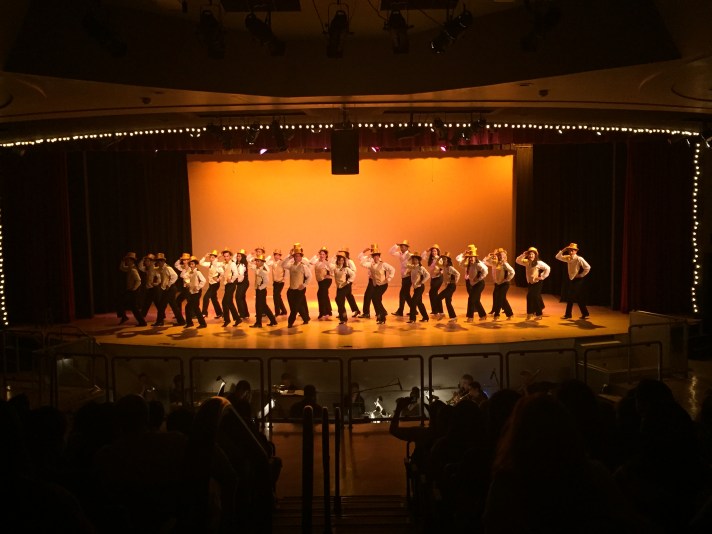
Dance dance reunion! The cast comes together to perform the final number “One.”

PHOTO: Elaine Zhang

By Patrick Trieu

PHHS alumni gathered to put on the musical A Chorus Line to celebrate 50 years of Piedmont Hills on Aug. 21 & 22 at the theatre.

The musical A Chorus Line tells the story of an audition for a Broadway musical, where ambitious professional performers hope to land a role while the demanding director Zach tries to only choose the best eight of the group.  In order to narrow down the selection, Zach decides asks the performers to share events that shaped their lives and their decision to become dancers.

Executive producer Anna Woods decided to choose the musical to represent Piedmont Hills’s 50th anniversary for its fame and suitable connection to our school’s celebration.

A Chorus Line has been known as the Golden Broadway Musical, and the 50th anniversary is the golden anniversary,” she noted.

The preparation for the musical was different from normal productions at the school, relying on satellite audition and casting, video instruction and the ability of each performer to master his or her part.  Furthermore, the cast only had 2½ days to rehearse for the show.

“Scheduling was difficult, but you just do what you gotta do and pull it off in the end like for every other show,” pointed out sound operator Winston Liew.

When the idea was sent out by the Drama Dept. through social media in January, many of the alumni shared the word with as many people as possible, ensuring the large assembly of alumni.

“We have a private page for the cast and crew involved in A Chorus Line.  So we’ve been posting info on there, giving people advice on what to post on their pages and asking people to post on Facebook, to use their Twitter, to use their Instagram,” described Class of ‘93 alumnus Liza Giron-Espinoza, who works as the Director of Alumni Relations for the production.

In preparation for their roles, the cast spent a great time in improving their singing skills and studying their character roles.  Due to the nature of the production’s scheduling, the entire cast had to practice their parts on their own before coming together for the 2½ days of rehearsal.

“It’s really hard to perform a piece that includes people using their bodies and having a live audience, and trying to get all the piece together while you’re apart when you are all supposed to be together on a stage,” detailed Class of ‘08 alumnus Rachel De Vera, who plays dancer Bebe Benzeheimer in the musical.

Everyone who took part in A Chorus Line express excitement, joy and nostalgia upon seeing the gathering of alumni in the cast and audience.

“It was a great opportunity to bring people back to their campus, to their Alma Mater, and our Piedmont Hills. And we did that,” stated Ms. Woods.