Thanksgiving traditions

By Erica Xie

Fall is here, and the start of the holiday season begins with Thanksgiving.

“(When I think of Thanksgiving), I think of turkey, football, a potluck and just family coming together,” shares junior Vy Truong.

Thanksgiving is a holiday synonymous with a feast, including, but not limited to turkey, mashed potatoes and gravy, dinner rolls and pumpkin pie that the whole family can enjoy.  This is also a time when families try to get together, even if they are busy or do not get along.

“My siblings and I try to get together at least once a year, but it’s hard since our schedules don’t match,” explains American Government teacher Lynne Murray.

However, not all people celebrate Thanksgiving the same; different cultures have changed the holiday’s traditions.  Many families have mended this day to their tastes, which encompasses the melting pot of ideals that is America.

“Most of my family is in China so we don’t have a big feast.  Instead, we go to my neighbor Lina’s house to eat chicken and other Chinese dishes that my mom makes,” explains senior Angela Du.

The commercialist culture of America also alters the holiday in the form of Black Friday.  Black Friday is the Friday after Thanksgiving that involves some of the biggest sales of the year and some people even include shopping as part of their Thanksgiving traditions.

“It’s sad that some stores open on Thanksgiving so (people) leave Thanksgiving dinner early to work or shop,” laments Angela.  “It takes away from the feeling of giving thanks.”

Others have different views about this day.

“I think (Black Friday’s) great because giving thanks is about thanking all the things that you have, and with Black Friday you can get more things to be thankful about.  Also, on Black Friday (we) usually have a family plan. One person gets a TV, and the other gets a laptop.  So really, it brings our family closer together,” replies senior Jennifer Lai.

Through all the changes, the core of Thanksgiving tradition remains: the concept of giving thanks.

“I’m glad that there’s at least one day in the year where people can come together with their families and give thanks,” maintains Ms. Murray.

So this Thanksgiving, remember to not only eat good food, chat with family members and shop for deals, but to also call up a friend or look your parents in the eye and thank them for all that they’ve done for you.
Holiday dinner etiquette

By Syed Rahim

Thanksgiving, with all its customs and traditions, is a tough holiday to understand.  Every family is different, and one with its own set of intricacies.  Navigating the maize (pun intended) of etiquette for this festive holiday can be tough, which is why The Legend staff has compiled some tips to guide you, courtesy of the Piedmont Hills student body.

“You pretend to know everyone even if you don’t remember them,” says junior Caroline Chou

This is a great strategy for the absent-minded, which is why it works wonders on long forgotten third cousins and friends of family who just show up.  An alternate strategy for forgetting someone’s name is referring to them as “old sport.”

“Just offer people things until everyone is comfortable,” suggests junior Bendon Tran.

This is generally sound advice for any party that you’re hosting.  The spirit of giving and taking is no more celebrated than on Thanksgiving, when we remember European settlers peacefully taking advantage of Native peoples.  Friends like to be offered delicious things like bananas, apples and mayonnaise.  Unfortunately, these foods may not be the right fit for everyone, which is why you should experiment with others and see what people accept.  Just know when to stop.

“Offer to clean up after the meal,” states junior Parmpreet Gill.

Cleaning up is often the most tedious part of a good Thanksgiving dinner.  Being a good friend means offering to tidy up the table, even if it means spending a few extra hours interacting with people you dislike.  If you’re the host of a Thanksgiving feast, you can always opt out of clearing the table.  This means exiting the dining room, waiting one year and reemerging to give thanks once more.  This method is not recommended for various reasons, and it’s probably illegal in some states.

Hopefully this guide helps you in some way, because we get it: Thanksgiving is scary.  The dizzying arrays of mashed potatoes and “gravy” flood the senses like no other day of the year.  But there is hope yet.  Thanksgiving is about giving, and giving is about compromise.  Compromise means wearing a smile on your face as you wade through puddles of small children.  This Thursday, remember to give thanks for the privilege of being miserable.

History of Thanksgiving

By Mae Castellano

Thanksgiving started 396 years ago in 1620.  It began when the Mayflower left Plymouth, England, with the voyage lasting 66 days and carrying 102 passengers.

The Plymouth colonists arrived to Cape Cod on Nov. 11, 1620.  The colonists were originally supposed to settle near the Hudson River but were forced to settle near Cape Cod because of poor winds.

According to history.com, after five months in New England, the Plymouth colonists, later known as Pilgrims, first made contact with a Native American: an Abenaki Indian.  A few days later, the Abenaki Indian came back with Squanto, a member of the Pawtuxet tribe.

Squanto began to teach the Pilgrims different skills, including cultivating corn, extracting sap from maple trees, catching fish in rivers and avoiding poisonous plants.  Most importantly, Squanto helped forged an alliance with the Wamponoag tribe which lasted for more than 50 years.

In November of 1621, former Plymouth Colony Gov. William Bradford organized a celebratory feast for the Pilgrims’ first successful corn harvest, and invited their allies.  The feast lasted three days and is acknowledged as one of the first Thanksgiving celebrations in the colony.

The Pilgrims’ second Thanksgiving occurred in 1623.  It was a feast to celebrate and mark the end of a long drought that threatened the year’s harvest.

166 years later, in 1789, former United States Pres. George Washington issued the first Thanksgiving proclamation.  He asked Americans to express their gratitude for the happy conclusion of the country’s war.

Following that event in 1817, New York was the first of many states to adopt an annual Thanksgiving holiday.

Wanting Thanksgiving to become a national holiday, magazine editor and prolific writer Sarah Josepha Hale launched a campaign in 1827.  She was insistent for 36 years, and finally 16th Pres. Abraham Lincoln heeded her wish in 1863.

Lincoln scheduled the final Thursday of November as Thanksgiving.  This trend was celebrated up until 1939, when former Pres. Franklin D. Roosevelt moved the holiday up one week to attempt to spur retail sales during the Great Depression.

This plan was met with opposition, so he reluctantly signed a bill in 1941 to have the celebration of Thanksgiving be held on the fourth Thursday of November, and the date has been celebrated since.

Pirate of the Issue: Tyler Seawright

p-01-tyler-seawright-credit-tyler-seawright
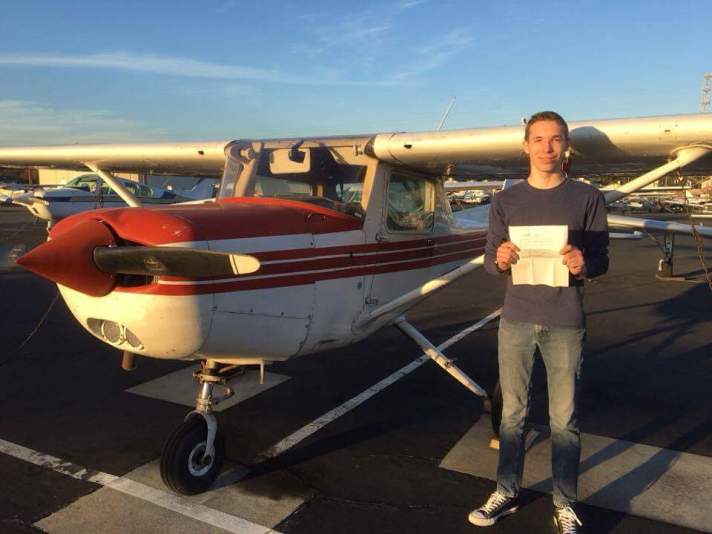
ON CLOUD NINE! Tyler poses with his pilot’s license. (Picture Courtesy of Tyler Seawright)

By Arthur Hoang

On Oct. 26, senior Tyler Seawright received his pilot’s license after only one year of taking lessons.

“It’s different from driving,” explains Tyler.  “My dad flies, and it’s inspiring.”

Tyler began flying at the Reid Hill View Airport of Santa Clara County after taking lessons with the company, Nice Air: Professional Piloting Training.  Before even getting into the air, however, he was required to take three months of ground training to study piloting.

“My first pilot training was a little bit scary, and it took some practice and coordination to start the plane,” confeses Tyler.  “Landing was a skill I really had to develop over time.”

After a total of 55 flights with a teacher beside him, Tyler endeavored 11 solo flights.  Some memorable trips include flying to Sacramento, Calif. with his flight instructor, going solo around the airport for the first time, and traveling to Madeira, Calif., which proved to be his longest solo flight thus far.

Tyler flies a Cessna 152 Single Engine and Lane plane.  Over summer, he spent quite a bit of time practicing his flying; at the beginning of the semester, however, he flew two to three times per week.

“Any time I get, I try to fly,” admits Tyler.  “Usually I fly two to three times a week.”

Through piloting, Tyler has learned persistence and patience in whatever he does.  To him, flying is truly full of excitement.

Most students who get their driver’s licenses would stop right there, but senior Tyler Seawright went beyond and got his pilot’s license.

Tyler first started taking lessons last year with the company Nice Air: Professional Piloting Training and started flying at Reid Hill view Airport of Santa Clara County.  After one year of flying, Tyler finally received his pilot’s license on Oct 26.

“It’s different from driving. My dad flies, and it’s inspiring,” exclaimed Tyler.

Before Tyler could even get into the air, he was required to take three months of ground training to study piloting

During his first actual piloting training, Tyler was really nervous. It was his first time taking off for real.

“It was a little bit scary, and it takes some practice and coordination [to start the plane] and landing was a skill I really had to develop over time,” confessed Tyler.

After 55 total fights with a teacher beside him, Tyler was required to take solo flights. In total he took 11 solo flights.

Some memorable trip that Tyler had was to Sacramento, Calif. with his flight instructor, his first solo flight around the airport and his longest solo flight was to Madeira, Calif.

Tyler flies a Cessna 152 Single Engine and Land plane and has flown across California to places such as Tracy and Sacramento.

Tyler has spent all of his summer and after school time practicing his flying.

“Any time I get I try to fly… Usually I fly two to three times a week,” explained Tyler.

During the beginning of the semester Tyler still flew, usually two to three times a week.To Tyler, flying is a lot of fun and is really exciting. Through piloting, Tyler has learned persistence and patience in whatever he does.

Carpentry builds tiny house

n-03-tiny-house-david-fredericks
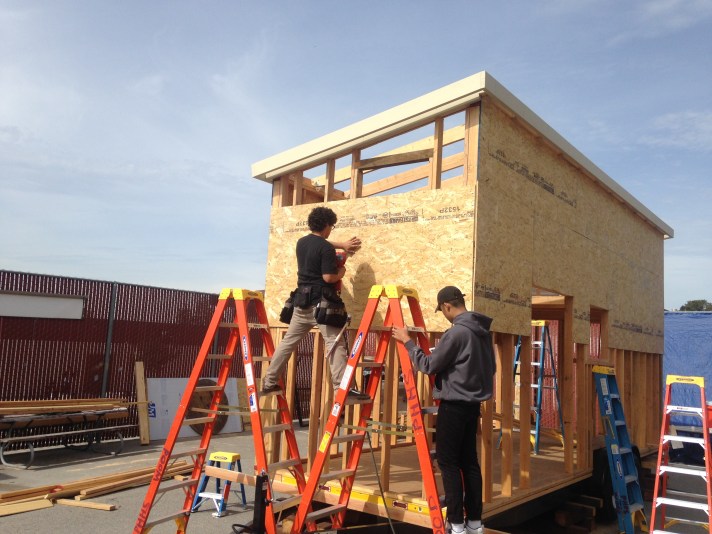
SMALL STEPS, BIG FUTURE Carpentry students work hard on constructing tiny house behind the K-Building. (Picture Courtesy of David Fredericks)

By Trevor Glassey

Our Construction Technology Class (Carpentry) is currently building a tiny house in the fenced area behind the K-Building, and plans to start work on a second.  According to Construction Technology teacher David Fredericks, the leader of the five teachers in the project, this is part of a new curriculum emphasizing construction.

“We redesigned the curriculum to be construction based because that’s where the need is in the industry,” asserts Mr. Fredericks.  “The skills these guys are learning coming out of high school will start at $30 an hour in a union apprenticeship.”

Starting back in September, this change to the curriculum is quite significant as the project regularly pulls in many students after school every weekday to work on the project. The first tiny house is projected to take most of the school year to finish.

According to senior Andrew Giluso, they often stay until six or seven working on it.  The time is primarily being spent to finish the first house, but while waiting for pre-assembled parts like windows. They have started the second house.  The students learn about construction on a small scale, within a school year, as they have to craft the purchased materials into usable parts, put together the house and add the essentials of plumbing and electricity.

This project is part of the CTE (Career and Technical Education) program which aims to teach students real life applicable skills.  The four main departments of Social Sciences, English, Math, and Science are represented respectively by history teacher Joshua Berry, English teacher Ryan Lundell, math teacher Richard De La Rosa and science teacher Jonathan Montoya, who each believe in the project’s goal to see students well-rounded. They give them many opportunities and work to keep students in the program doing well in their other classes.  Most students in the program end up with even better grades after joining the program.

“(The program) opened my eyes to different opportunities,” explains senior Rafael Rodriguez. “I have more options.”

In today’s world, the idea of having to go to a four-year college is becoming increasingly prevalent.  However, the CTE program tries to show that there are other perfectly valid ways of life.

The monetary cost is lowered due to funding from Economy Lumber, whom the department gets its tools and supplies from.  As it turns out, this project was suggested by Director Tim Nguyen to both Piedmont Hills and Independence High School, who started their house back in spring.

“We expressed interest, and we have a buddy over at Independence, Jeremiah Ellison, building one as well,” answers Mr. Fredericks when asked about the start of the sponsorship.

This tiny house is part of a new housing trend showcased by a show called Tiny House Nation that is about people downsizing to these tiny houses to limit environmental footprint.  These tiny houses could also serve a not-so-tiny role in combating California’s large and growing housing crisis.  While Mr. Fredericks doesn’t know where the houses are going right now, he predicts it will end up either sold or donated. Whatever their fate, the tiny houses are likely to make a big difference for both the students working on them and California as whole.

Sommer’s Salt

By Sommer Fowler (Special Columnist)

Officially, there are about 70 clubs that exist on campus. Each club has at least one advisor, assigned meeting space and president. There is not a single weekday without multiple club meetings happening during lunch. Club officers harass their innocent Facebook friends to attend copious fundraising events at just about every possible teenager-approved eatery. Clubs at PHHS manifest student lives, but with so many available the line between valid and illegitimate blurs.

Becoming an official ASB club entails finding a willing teacher to assume the role of club advisor and donate classroom space for meetings—at least twice a month—yet only requires ten members and four officers. This allows a small group of friends to occupy a teacher’s precious time, preventing students from approaching their teacher for help. Although club advisors are not required to participate in club meetings, it is rather difficult to consult a teacher about an essay while chirpy officers are grabbing for their members’ attention and bellowing out announcements.

With such a low required count of members, a student can easily become president of their own club then do the bare minimum to maintain official status; most club officers are only looking for a shiny title to write on college applications. After the officers graduate PHHS, the club descends to the cemetery of forgotten causes. If the requirements for official clubs were tightened, it is doubtful every prospective club president would be passionate enough about their club to pursue ASB status still.

Many clubs are twins. They are nearly identical, but just different enough to distinguish after a close inspection. As a result freshmen filter potential clubs, especially with the abundance of similar community service clubs, through criteria more often than not unrelated to the club.

This is not to say PHHS should rid itself of all clubs. They are a vital component of student life and bolster friendships that a classroom never could. That being said, perhaps potential clubs seeking ASB status should be looked at more critically than in the past. Those looking to share a hobby may wish to consider gathering outside of school hours, on their own time. These conditions are suggested not to discredit smaller clubs, but rather strengthen genuine clubs that wish to positively impact PHHS.

Red Cross holds fall blood drive

By Anthony Ta

Red Cross held its fall blood drive this past Friday in the library.  Members and officers alike participated in donating blood and running the event through Blood Centers of the Pacific.  Donors were required to be at least 16 years old, fill out a waiver out if they’re under 18, and pass the screening process before being able to participate in the blood donation.

“I think the obvious thing is you are giving to hopefully help to create the blood banks that will make it better for people who need blood transfusions,” says Mr. Vasques, “and also makes students aware of what they can do to help others.”

Students who signed up for the event were pulled from their selected classes and brought over to the library.  The donated blood was then delivered to local hospitals in the area by the Blood Centers of the Pacific at the end of the drive.

“I was really nervous because I really don’t like needles, but when you are doing [it] to save someone else’s life, it encourages you to go through with it,” says senior Ryan Phong, “I would definitely do this again.”

“About 37% of people are eligible to perform a blood transfusion, but only about 10% of people do,” states Red Cross Board Member Annemarie Gali.

According to the Red Cross website, the club pushes towards preventing and alleviating human suffering “in the face of emergencies by mobilizing the power of volunteers and the generosity of donors.”

“One pint of blood can save up to three lives,” explains Red Cross President Nancy Le, “these pints of blood will go to local Bay Area hospitals so it will make a direct impact on the community.”

The club hopes to be able to get students to continue to spread the word about the importance of donating blood and to do so, if eligible, for as many years as possible.

“It is nice to know that I am helping people and at the end of the day you end up feeling better about yourself knowing that you were able to help save 3 lives,” beams two time donor Jeffrey Chang.

Holding a blood drive is nothing new to the Piedmont Hills club.  In the past, Red Cross has worked with the Blood Centers of the Pacific to run six successful blood drives.

One Way Christian Club brings joy to children

By Bernice Ou-Yang

Since Oct. 29, One Way Christian Club has placed many boxes inside classrooms throughout the school for OCC (Operation Christmas Child).  OCC was brought up to the club by their former advisor.  By donating toys, educational utensils and personal hygiene products, the students of PHHS are donating to help needy children around the world.

“We put (the donated items) in shoe boxes, and then we give them to nearby churches that are doing the same to ship the boxes,” says Vice President Jeremiah Porda.  The organization in charge of the OCC has its own shoe boxes.  The club had ordered many of those boxes, hoping to fill each shoe box.  They then drop it off at a church, who ships it to a processing center where volunteers inspect and prepare the boxes for international inspection.  Those boxes are shipped to different countries where they are distributed to the children there.

“This year, we have decided to try to involve the entire school, in hopes that we can collect more donations” states Co-President Gabi Ng.  In the previous years, the club’s OCC didn’t involve the entire school.  The officers and members wanted everyone in the school to be able to participate, hoping that this will also get more donations to pack into boxes for those children.

“I hope to see many children smiling from these gifts and hope that many of PHHS students participated too,” wishes Jeremiah.  The officers and the members of the club all wish and hope that these donations will help make those children happy and show them that there are people in this world that care.

NHS tutors at Ruskin Elementary School

By Andrew Huynh

NHS (National Honor Society) members are giving back to their local community by tutoring young kids three times a week at Ruskin Elementary School.

Members have opportunities to tutor after school every Monday, Tuesday and Wednesday.

“It’s really interesting and it’s fun getting to work with kids from an elementary school that a lot of PHHS students went to,” says Treasurer Elyse Nguyen. “It gives the teachers a helping hand and there’s a bunch of different students there.”

“We wanted to help out those kids in our community,” states President Brandon Dimapasoc.

Since NHS has tutored at Ruskin in the past, setting up a schedule for this year was done by contacting teacher Pamela Colara, who was the same teacher NHS assisted last year.

“The NHS members rotate around the schedule, and each member does at least one session per semester,” informs Secretary Jennifer Lai.

“I’m friends with one kid,” informs Elyse. “We help them in a lot of different subjects which is fun.”

Members of the club are not just limited to the weekly tutoring sessions at Ruskin. Each member is also responsible for finding and committing to their own personal community service projects.

“My personal community project is tutoring kids at Sunshine School,” explains general member Jaria Jaug.

Aside from helping in the local community, NHS also helps internationally. This year, the club is working alongside Save the Children, an international non-governmental organization that promotes children’s rights and provides relief and support to children in developing countries.

“NHS brings so many people from different clubs together to work on different and amazing things,” says Brandon. We hold fundraisers to raise money for Save the Children.”

Cross Country finishes the season strong

jonathan-chu-xc-ccs-f
SONIC BOOM! Senior Jonathan Chu bolts through CCS. 

By Vivian Lin

On Nov. 12, fifteen members of the Cross Country team competed in the CCS (Central Coast Section) race in Belmont, Calif. at Crystal Springs.  Eight runners from the Varsity Girls’ team and seven runners from the Varsity Boys’ ran at the competition.

The competition started at 11am and ended at 2:30pm, with the boys’ race starting at 12:20pm and the girls’ starting at 12:50pm.

The course ran for three miles: the first mile consisted of downhill and uphill terrain, the second mile of flat land and rolling hills and the third mile of rolling hills.

“They all ran the course with no problem so I think it went well.  Everyone felt that they could have done better, but I really love how they went out and ran their best,” exclaimed manager Elaine Luong.

Photography teacher and Cross Country coach Ian Tippetts has been training the team intensely for the big day by adding several weeks more to the cross country season just for their practice sessions.

CCS practices were also handled differently than normal season training, with longer runs and harder sets.  Because the number of runners was cut down to fifteen, training became a lot more personal as well.

“CCS training is a little different because Mr. Tippetts focuses on us more than the whole group itself, so we get more individual coaching,” explained sophomore Samantha Tran.

Running for the Varsity team proved to be a challenge for some, but runners overcame their obstacles through hard work and determination.

“I’m a JV girl that went up to Varsity.  (The Varsity runners) run faster than I do during practice so I’m running faster during practice and it’s pretty hard,” revealed junior Cindy Hoang.

“Last year I didn’t race on Varsity.  I liked racing on varsity (this year) and racing with other people.  They pushed me to be faster, so it was a good experience,” commented sophomore Henry Zheng.

The Varsity team also had many bonding events, like getting dinner after runs and having rap battles with other team members during Team Night which was on the eve of CCS.

“(CCS) was kind of sad because it was the last race of my high school career.  What I’ll miss the most is the environment, the good attitudes,” reminisced Varsity Boys Captain Austin Rubalcava.