Track team races into action with a bang

By Vivian Lin

The track and field season officially started practice on February 20th. Every day for about two hours after seventh period, the athletes go to the school track to run, sprint, jump, and more.

“A typical practice usually starts with warm ups that basically get your heart pumping, and the coaches are really strict about us wearing our sweats during this so that we actually get warm,” explains junior Bryce Smith, who runs sprints.

The workouts vary depending on what event the particular athlete participates in. For example, a distance runner might do mile repeats with a few breaks in between, while shorter distance runners might do sprints.

Track and field is a physically taxing sport that requires athletes to look after themselves before and after practice. The athletes often use ice to put on sore muscles and use foam rollers to massage their muscles after practice.

“Before practice, I drink a lot of water and make sure I’m eating the right foods and after practice, I make sure I stretch,” remarks sophomore Gloria Qiu, a distance runner.

The team’s first meet was at Sobrato High School on Thurs., March 9. Several members were missing due to the music department trip to Disneyland, resulting in free points for the opposing school, but the meet went smoothly overall.

“For me, the hardest thing about sprinting this year is getting used to the more explosive speed that you have to hold during the event,” admits senior Brandon Nguyen, who ran distance last year.

In the end, Piedmont Hills came out on the top with a strong win.

“Even though most of the events are individual, except the relays, the scores are tallied up as a team, and we are more of an extended family than a team,” says Bryce.

Golf team tees off in a new course

By Syed Rahim

Coming off of a second seed placement at the end of last season, the Piedmont Hills Golf team practices as it looks forward to a new year. With a fresh squad guided by experienced veterans, the Pirates squad plans to train hard to beat their competition.

Last year, the Piedmont Hills Golf team ended the season with a 9-3 record, coming in at second place in the Santa Teresa division.

Last year, we were really good,” remembers sophomore Stephanie Lee. “We beat every single team except for Santa Teresa, which was our last team.”

This season, the team looks forward to training a better team and scoring a better record. Veterans of the team recall the process of training new members and practicing together last year.

Our coaches really taught us how to play the game and understand as a team who we are,” comments senior Jasmit Mahajan. “We learned strengths and weaknesses throughout the year and practiced as a team so that we got better and understood other people’s strengths and weaknesses.”

In this new season, playing against B-league newcomers Branham High School, the team will have to work even harder to secure another impressive record. The team also hopes to make it to CCS (Central Coast Competition), where they will be playing against teams from leagues all over Central California.

“Personally, as a girl player, I want to give girls recognition for playing since I play on the boys team. I want girls to see “oh she can play golf, I can play golf too.” says Stephanie.

All things considered, the Pirates’ Golf team is confident in its ability to win. The veterans are looking for a chance to go deep in the playoffs, and the newcomers are looking to prove their spot on the Pirate squad.

Empowering today’s women

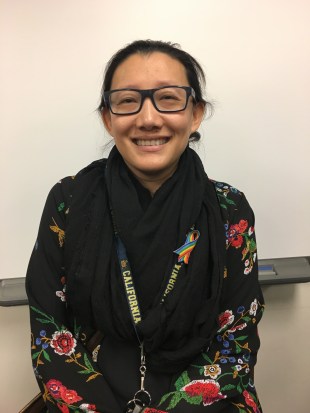
SLOS.01.MsLee2
LEE-VE IT TO LEE! Ms. Lee gives a strong voice to feminism

By Michelle Lin

Women’s History Month is a time when the power of women and gender equality is widely celebrated. English teacher Peggy Lee is a strong representation of women today, not only having welcomed her newborn baby boy into her life this past year and experiencing the hardships of motherhood, but also having realized the misconceptions of both feminism and gender roles in society.

“I went on maternity leave for a semester,” explains Ms. Lee. “The experience is tough. There’s moments of the responsibilities that I don’t love. This doesn’t mean I don’t love my child, but I don’t love everything that goes with motherhood.”

After raising her now one-year-old son, Ms. Lee has reflected upon her own experiences and the idea of feminism with careful consideration.

“I really think feminism is about ‘togetherness,’” says Ms. Lee. “It’s about equality, equity, embracing who we are. It’s about being free.”

Her husband shares the burden of raising their child, a key piece of what feminists today should be working towards, according to Ms. Lee.

“(My husband) never defines that these are the things a mom does, or these are the things a dad does,” elaborates Ms. Lee. “He just defines it as ‘we are the parents, and these are the things that parents do to bring up a child.’ It really bothers me when some people define feminism as separation of genders.”

With a perspective on feminism different from what is generally portrayed by the conservative media, Ms. Lee hopes to find the more human side of feminism by educating people on a more inclusive way to view it.

“The feminists before me that have mentored me have all been about kindness and showing me how to speak up and not be afraid. They never tore other women and men down, and I just really respect that,” remarks Ms. Lee.

Women’s History Month has been all about promoting gender equality and kindness within society.

“We don’t celebrate great contributions to society as much as we want,” admits Ms. Lee. “So if it takes a month to celebrate women, that’s pretty fabulous, I think.”

Jam in your jammies with InterKey

By Emilie Chau

Piedmont Hills’ Interact and Key Club hosted their annual Interkey Pajama Jam on Feb. 17 in the library.  The event included food and drinks, a monster-themed photobooth, a screening of Monsters University and fun games in order in order to strengthen the bond between the two clubs and to raise money for each club’s project.  The event lasted from 4 pm to 8 pm and admission was $1.

The clubs held an Interkey Spirit Week from Feb. 13 to Feb. 17 in order to build up the excitement for the Interkey Pajama Jam. Monday was Monsters Day, Tuesday was Service Day, Wednesday was Vakeyta Day, Thursday was Me, The Human Can Eliminate Day and Friday, the day of the event, was Pajama Day.

“The officers came together and we divided the work into different committees,” explains Key Club Senior Representative Brandon Dimapasoc on how they prepared for the event.

Like previous years, the purpose of the event was to raise money for each club’s project and to strengthen the bond between the two clubs.

“(We wanted to) foster bonds between Interact and Key because we are often seen as rival clubs but that is not the point of our mission,” comments Interact Co-President Tiffany Nguyen. “We are both clubs who really value service so this event was a way for members of both clubs to really get to know each other.”

Key Club’s Eliminate Project is to raise funds to fight MNT (maternal neonatal tetanus), a disease that “steals the lives of nearly 49,000 innocent babies and a significant number of women each year,” according to the club’s website.  Newborns suffer from extreme pain and sensitivity to light and touch due to the disease.  The Eliminate Project is also one of UNICEF’s projects for this year.

Interact’s Me The Human project aims to raise money for the Syrian Refugee Crisis, the “biggest humanitarian and refugee crisis of our time,” according to the Interact District 5170 website.

“The purpose was to raise money for Interact’s project, Me The Human, and Key’s project, the Eliminate Project,” explains Brandon.  “We also wanted to foster friendship and partnership between Interact and Key.”

At the event, members played board games and ice-breakers in order to cozy up before watching Monsters University.  The clubs also sold concessions such as milk tea from Cool Tea Bar and spam musubi.

The clubs were able to raise $177 from the event.

Math teachers celebrate Pi Day

By Phuong Nguyen

Last Tuesday marked the yearly celebration of Pi Day. The international holiday observed approximately 3.14 days ago was dedicated to the irrational and continuous number of pi.

“I think it’s a very creative holiday for all the math-lovers in the world,” expressed junior Leann Le, a math lover herself.

For math teacher Rey Enriquez, celebrating this holiday meant teaching a lesson related to pi, if possible.

“In my statistics class, we would do some linear regression approximating pi,” explained Mr. Enriquez.

“I celebrated it by buying a pie or baking one myself! It could be any kind like apple pie, coconut cream, or key lime,” passionately exclaimed Leann.

According to Mr. Enriquez, another way of celebration was to measure a circular object and dividing its circumference by twice the radius to approximate pi.

“If you bring a pizza, then after measuring, you can celebrate by eating it,” laughed Mr. Enriquez.

Pi Day was especially commemorated in 2015 because the date (3.14.15) signified the first four digits of pi after the decimal. In fact, there was a math contest held by the Santa Clara Valley Math Association on that day.

This holiday commemorated not only pi itself, but the applications of pi to real life as well.

“Pi is very useful. For example, it is used in determining circumference, areas, and volumes of circles, spheres, and cylinders,” listed Leann.

However, the usefulness of pi in the real world may be subliminal.

“In terms of everyday uses for the typical human being, they probably won’t use pi, or at least they won’t know that they are using it, but they do benefit from it,” speculated math teacher Stewart Kuang.

New year, new rain

By Emily Zhao

Rain and snow storms ravaged much of northern California throughout January, with precipitation rates well above average and over ten feet of snow bury the state’s Sierra Nevadas.

The average rainfall in San Jose is 14.9 inches a year, 62% less rain than the national average. In the month of January 2017 alone, however, San Jose had a total of 7.5 inches of rain according to daily-weather.com.

With the end of 2016, California entered its sixth year in drought. Just one year ago, over 86% of the state was in severe drought. As this was the wettest January meteorologists have seen in recent years, the percentage of California that remains in severe drought has been reduced to 44%, according to San Jose Mercury News.

“Just because the condition of the drought is improving doesn’t mean that we should stop acknowledging it. We should continue to conserve water,” remarks sophomore Mignon Lee.

For the first time in years, California’s reservoirs are brimming with water. The two biggest reservoirs in the state, Shasta and Oroville, are 80% full, while many Bay Area reservoirs are completely full, reports Mercury News. Water is even being released from such reservoirs to prepare for potential flooding.

“We’re so used to living in California with the drought that once we see all the rain, we’re pretty surprised,” laughs senior Lauren Young.

The recent heavy precipitation isn’t the only thing that has relaxed drought conditions.

On May 9, 2016, Governor Jerry Brown issued an executive order to continue water conservation, declaring a number of preventative and remedial methods, from citizens not being allowed to hose down their cars to adopting better agricultural methods to fixing water leaks. Water distribution systems across the state alone leak an average of 700,000 acres-feet of water per year, enough water to meet the needs of 1.4 million homes for a year. Between June 2015 and Nov. 2016, Statewide Water Conservation calculated that over 2.5 million acres-feet of water were saved, according to gov.ca.gov.

“It’s a pretty serious problem, and everyone needs to do their part,” states junior Leo Guo.

While much of Northern California is no longer in severe drought, southern California and San Joaquin Valley remain parched in extreme drought conditions. After the wet month of January ends, the entire state is expected to experience a drying spell along the west coast, explained Weather West.

Although many PHHS students are happy about California’s receding drought, some have mixed feelings about rain.

“When it rains, the students who usually walk to school have to get their parents to drive, which increases the traffic. Also, we feel more inclined to stay in our warm beds, and we end up late to school,” jokes sophomore Gloria Qiu.

FAFSA and scholarship tips

By Hannah Tong

As seniors begin to finalize all their college applications, they move on to the next step: figuring out how to pay for college.

The two most efficient ways students find financial aid is through FAFSA (Free Application for Federal Student Aid) and scholarships.

The Federal Student Aid is a part of the U.S Department of Education and helps students across the nation afford college. Over $150 billion in grants, loans and work-study funds are provided to students to aid them in their college expenses.

“I wanted to take advantage of the opportunity to hopefully lessen the cost of my college tuition,” expresses senior Elaine Pham.

The FAFSA application opened on Oct. 1 and the official deadline is on Jun. 30. However, the FAFSA deadline can vary among select colleges.

To apply, students and their parents have to fill out an online application about tax returns, financial status and personal information.  After submitting, everyone just waits for the process to go through.

Scholarships are also a major part of the college application process.  They are grants or payments made to support a student’s education and are usually awarded on the basis of academic or other achievement.

Students can access several different websites to search for scholarships such as Fastweb.com, Zinch.com, Cappex.com or Scholarships.com.

Each scholarship has its own specific requirements.  Some may require essays, letter of recommendations and transcripts, while others just require an application concerning personal information.

For seniors who are still looking for additional scholarships to apply to, PHHS always has updates on upcoming deadlines for specific scholarships either on Schoolloop or the PHHS home page. Students can also look under the “Guidance” tab and select the “Financial Aid/Scholarships” section to find a long list of scholarships.

VSA hosts star-studded show

By Phuong Nguyen

On Jan. 14, VSA (Vietnamese Student Association) hosted its annual cultural show.  It presented a variety of performances such as skits, singing, umbrella dancing, hat dancing, magic tricks, and ended with a fashion show and a waltz exclusively for VSA officers.

Usually, Vietnamese teacher and VSA advisor Lily Lam’s Vietnamese 3 and 4 classes have their own cultural show in December, while VSA’s show is in May.  However, this year, her classes performed with VSA as well.

“This year, it was harder because Drama took up a lot of our tentative performance days so we had to book an earlier show.  This year, we have (the VSA show) in January when usually we have it in May,” reveals historian and publicist Cindy Nguyen.

The theme this year was “Under A Thousand Stars.”

“Before, we would come up with ideas (for the theme of the show) within the cabinet and then have a vote on it within the cabinet,” discloses Co-President Roselyn Mai.  “But this year, we thought of them and posted on our group page on Facebook and let the members decide what they would like to do.”

After choosing the theme, the VSA club officers determined practice dates and started preparing for the upcoming show with Ms. Lam’s Vietnamese 2, 3 and 4 classes.

“At first, it’s really hard because your group has to come up with ideas and make it fit into the time limit.  But then once you get everything settled and start practicing, it becomes easier because it’s like you’re completing a plan,” comments junior Thy Tran Hoang, who is currently in Ms. Lam’s Vietnamese 4 class.

The officer waltz was first added in last year’s VSA show.

“My most memorable moment was either the waltz or the ending because the senior speeches always bring us officers (and) the seniors to tears,” reminisces Co-President Lyann Bui.

“The moment before the curtains open (was the most memorable to me).  When you’re in the back and setting up, you get this anxiety that comes along with you throughout the performance, but you don’t realize it until the end,” explains Thy.

“At the end (of the show), the parents really enjoy seeing (their kids onstage). I like it when the shy (kid) gets to be on the stage,” smiles Ms. Lam.

Academic Competition of Bay Area Students

By Sophia Xiao

What’s happening to the students of the Bay Area?

We live in Silicon Valley, a place that leads the world in technology.  Somehow, it only makes sense that its children must lead the world in academics.  This is what millions of Bay Area students tell themselves every day as they struggle through ever increasing college standards, AP classes and anxiety.  And to a degree, the “work hard now to play hard later” idea makes sense because hard work means a better college which means a better job which means higher pay which hopefully will finally turn into a happy life.

However the cost of this philosophy, especially here in the Bay Area, and especially now more than ever, is piling.

“Gunn was ranked by U.S.  News World Report as one of the nation’s top five STEM schools.  Every year, about 20 of its seniors get into Stanford and a quarter are offered spots at University of California schools,” wrote The Atlantic.  Yet despite its academic success, the Palo Alto School District has had two suicide clusters, one in 2008 and one in 2014.  Seven students, many of which had promising futures, committed suicide.  All of a sudden it seemed, news reporters flocked to nearby schools like Gunn and Mission, and administration finally woke up to try to control the mental health crisis.

At the end of 2016, Newsweek’s rankings had 11 Bay Area schools in their top 100 US private high schools list and 14 schools in their top 500 US public high schools list.  These powerhouses are all surprisingly close to home– Monta Vista, ranked 18th, and Lynbrook, ranked 29th, are both less than half an hour drive away.  With the culture of Silicon Valley success and these nationally ranked schools breathing down our necks, it’s no wonder Piedmont Hills students are feeling the stress to outperform and overachieve.

Why are the schools around here so competitive?

With four AP classes, two club officer positions, a job, and other achievements to pad her resume, senior Sarah Dao’s schedule is packed.

“I know that the way I’m stressed right now isn’t really healthy, but I also think it’d be a waste if I don’t give it my best,” confesses Sarah.

This mindset to always be the best is common.  A big reason for Silicon Valley’s academic success is that it is filled with hard working immigrants who have come to give the best life they can to their children.  These immigrants believe that since they worked so hard for their kids, the kids should obviously work just as hard for themselves.  A further reason for this Silicon Valley mindset is that 32% of San Jose’s demography is Asian, a culture which emphasizes obedience, high standards and constant success.

We live in one of the most expensive places to in the US, and the expectation is that we become an engineer and work for one of the tech giants next door.  This pressure to be outstanding is what makes Bay Area students successful but is also what drives a lot of students to their breaking point.

“There is definitely a pressure to overachieve.  I’m always looking down on myself as an underachiever since everyone else is taking all these extra classes,” admits sophomore Steven To.

“It’s just society’s standards now,” Sarah states simply. And it’s true. For students who judge themselves based on how impressive they look on paper  to colleges, average is nowhere near enough.

“Students are definitely coming in with more competitive classes, with higher classes… I think it is part sort of colleges (responsibility/fault), but I also think it’s just part of our society and how it’s changed in the sense of how competitive it’s gotten and the stress it puts on students,” agrees Counselor Justine Kunkel.

Okay, but is this stress necessarily a bad thing? It only lasts for four years anyways, right?

As more and more kids get access to private tutoring, music classes, college counseling and other extracurriculars, people are finding more ways to get a competitive edge over everyone else.  Parents start their children on this path to college with the idea “the younger the better.”  This poses a problem to kids who have grown up with overachievement infused into their identity.  Fear of failure is something that students are taught in order to get into college, but by then, these habits and lifestyles are hard to get rid of, causing long term stress and anxiety.

“I obviously do have students that strive off of stress.  It moves them and motivates them to get things done, but we do have a large number of students here that sort of give in to the stress and it really affects them.  Ultimately it can lead to the other grades falling and mental health issues.  So I would say that (academic stress) is more a detrimental than a positive thing,” expresses Ms. Kunkel.

Something new that has popped up recently is an entire industry based solely on getting kids into specific colleges.  Of course, it makes sense for parents to hire help for something as important as getting into good colleges.  However, college counseling reinforces the culture of tailoring students’ lives towards college, as if many students don’t base a large portion of their lives off of the admissions process already.

Additionally, counseling creates an imbalance among students with different backgrounds.  It gives those who can afford them an unfair advantage over the students who simply don’t have those kinds of resources.

So how do we regain control of our lives?

In the midst of this chaos known as high school, it is important to slow down and take more breaks from the all consuming goal known as college.  You are the one who decides your fate, not the college you go to– a different one won’t make or break you.  Allow the things you do for college to also be things that you love.  For example, Sarah, who enjoys graphic design and music, is publicist for NHS and president of the Instrumental Club.

Likewise, remember that you don’t have to take all the APs and extracurriculars in the world.  If you genuinely hate and suck at math, then taking that AP Calculus class may not be the best idea.

I’m not saying to stop pushing yourself to do more, but don’t do it for the primary purpose of getting into college.  You don’t want to wake up one day after graduating from college and have no idea what to do next because all you’ve ever done was for it.

And listen to Steven’s advice: “There will be times where you procrastinate, and that’s fine.  We’re not perfect, but at the same time, we’re also capable of great things.”

Compared to even four years ago, college admissions have tightened considerably, and it’s reflecting on our high schoolers.  Nine years ago, it took a suicide cluster of 4 students for the Palo Alto High School District to implement significant measures for the safety of students.  How long and what will it take for we, as students, to start taking our own mental health more seriously?